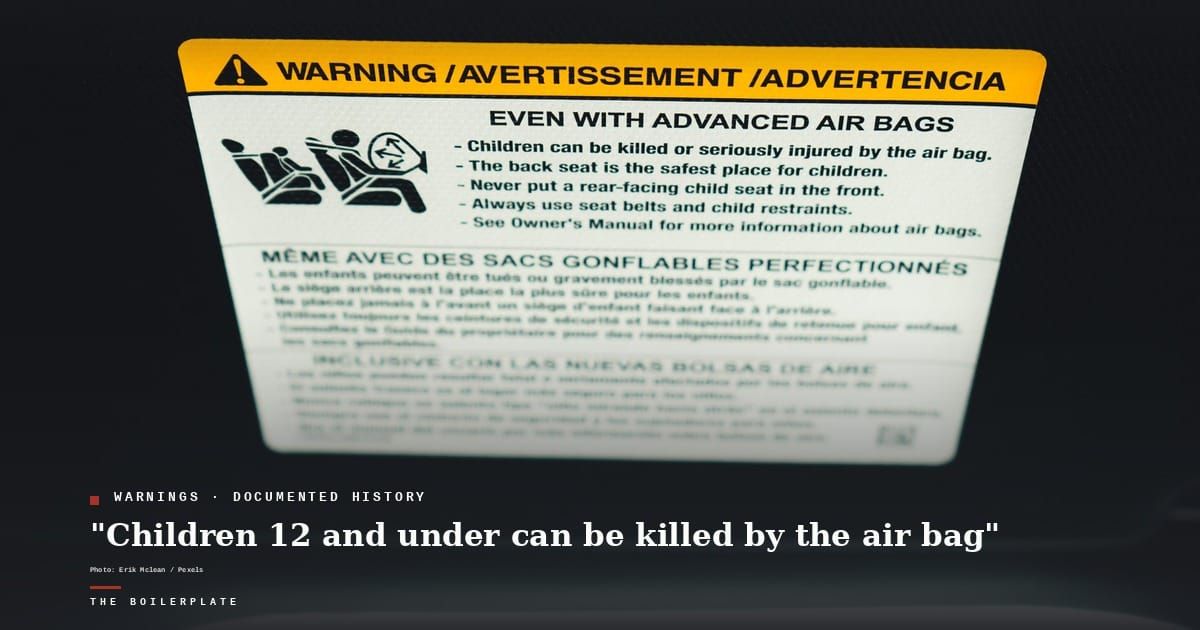
WARNING
DEATH or SERIOUS INJURY can occur.
- Children 12 and under can be killed by the air bag.
- The BACK SEAT is the SAFEST place for children.
- NEVER put a rear-facing child seat in the front.
- Sit as far back as possible from the air bag.
- ALWAYS use SEAT BELTS and CHILD RESTRAINTS.
The Language
Look at the underside of your car's sun visors, on both the driver's and the front passenger's side, and, if the vehicle has air bags, you will find the warning quoted above permanently affixed there. It is not a suggestion from the dealer or an insurer's idea of prudence. It is required, word for word, by a specific federal regulation, and it applies at every front outboard seating position equipped with an air bag.
That regulation, Federal Motor Vehicle Safety Standard No. 208 ("Occupant Crash Protection," codified at 49 CFR 571.208), fixes the label's appearance down to the millimeter, not just its words: a yellow (shade indeterminate) heading area carrying the word "WARNING" and an alert symbol in black; a white message area with black text at least 30 square centimeters (4.7 square inches); and a black pictogram, a figure struck by a red circle and slash, at least 30 millimeters in diameter.
In spite of the regulation's precision, the one thing it never quantifies is the color itself. "Yellow" is the whole specification. No Pantone number, no Federal Standard 595 chip, no cross-reference to the ANSI safety-color standard. Fifty shades of yellow could all comply.
Vehicles without a front passenger-side air bag are permitted to use an alternate, shorter version of the label, a variant made possible by a correcting amendment NHTSA issued a week after the rule above took its final form (more on that below).
Plain-English Translation
Stripped of the regulatory framing, the label is telling you five things: an air bag deploys with enough force to seriously injure or kill; children 12 and under are specifically at risk from that impact; the back seat is the safest place for a child to ride; a rear-facing child seat must never be placed in the front, where an inflating air bag would strike it directly; and everyone in the vehicle should be using a seat belt or an age-appropriate child restraint.
None of that is generic caution language filling space. It is the specific safety message a federal agency decided drivers and passengers needed to see every time they flip that visor down.
Before This Language Existed
The wording above is not the first air bag warning label ever required on a U.S. sun visor. FMVSS 208 already required some form of sun-visor air bag warning label years earlier; a March 1994 interpretation letter from NHTSA's Office of Chief Counsel refers to "the air bag warning label" as an already-established requirement, distinct from a separate rollover label some vehicles also carried on the visor at the time.
We could not confirm which specific rulemaking first imposed that earlier requirement, or recover its exact wording. What can be said with confidence is only that some earlier, less-detailed version of the label already existed by 1994, well before the sentences most drivers now associate with the sticker.