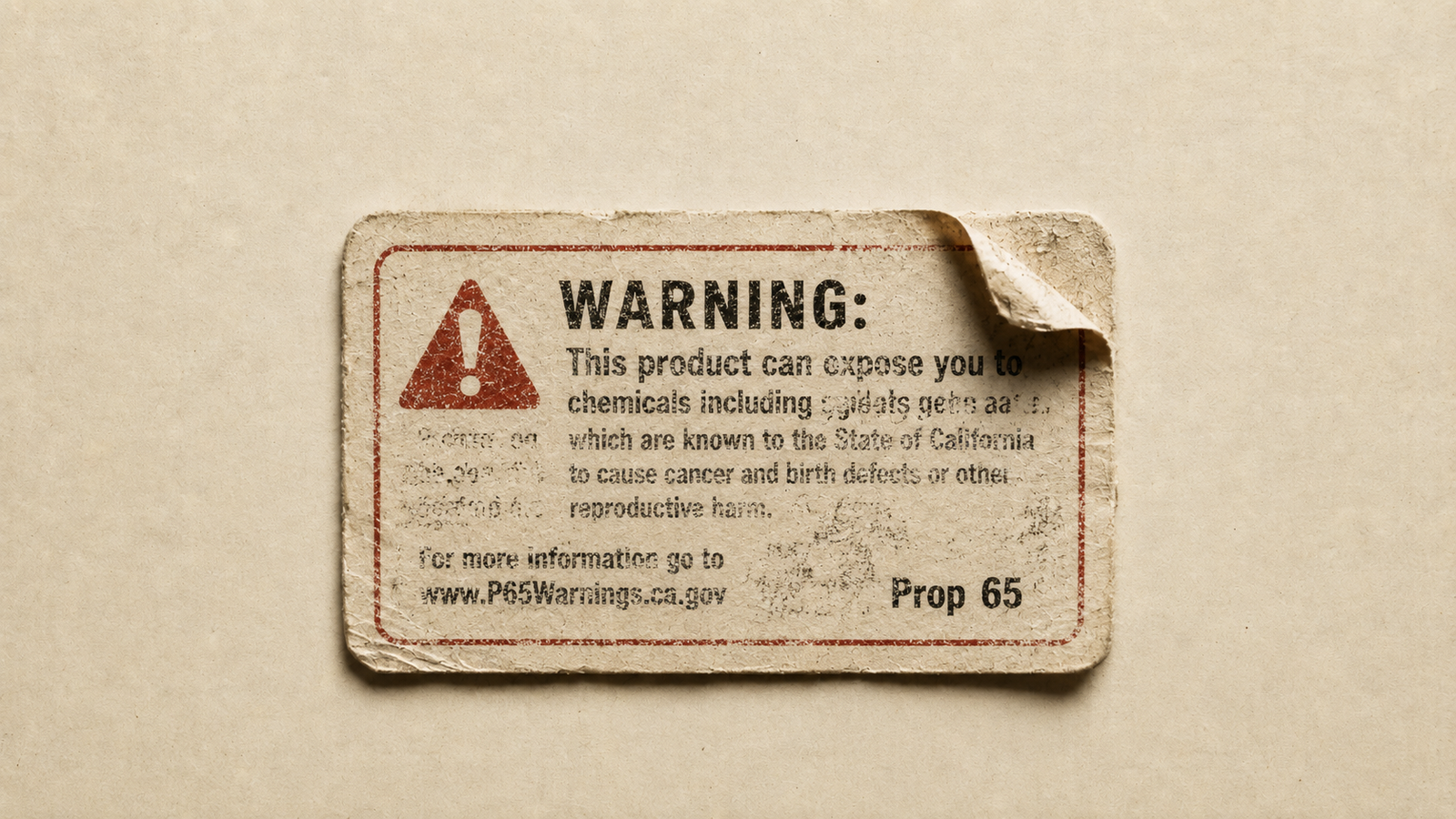
WARNING: Cancer - www.P65Warnings.ca.gov.
The Language
Three real instances of the wording, as California's regulations currently write it, the short-form warning used on small product labels:
"WARNING: Cancer - www.P65Warnings.ca.gov." — Title 27 CCR §25600 et seq., safe-harbor short-form
The long-form warning used for a chemical listed for both cancer and reproductive toxicity:
"This product can expose you to chemicals including [name of one or more chemicals], which is [are] known to the State of California to cause cancer and birth defects or other reproductive harm." — Title 27 CCR §25600 et seq., safe-harbor long-form (combined)
And the long-form warning used for a cancer-only listing:
"This product can expose you to chemicals including [name of one or more chemicals], which is [are] known to the State of California to cause cancer." — Title 27 CCR §25600 et seq., safe-harbor long-form (cancer-only)
None of these three sentences is the statute. They are regulatory "safe harbor" text, specific wording that California's Office of Environmental Health Hazard Assessment (OEHHA) has designated as automatically satisfying a separate legal duty. The statute itself, discussed below, never uses the phrase "State of California" at all.
Plain-English Translation
The underlying law, Health and Safety Code §25249.6, requires a business to give "clear and reasonable warning" before knowingly and intentionally exposing someone to a chemical the state has listed as causing cancer or reproductive toxicity; it does not, itself, specify the familiar sentence. The "known to the State of California to cause cancer" wording is OEHHA's regulatory safe-harbor language: text a business can use to be treated as having satisfied that statutory duty without litigating, case by case, whether its own phrasing counts as "clear and reasonable."
A chemical can also reach the operative warning list because an outside scientific body - the International Agency for Research on Cancer, the U.S. EPA, or a similar body - has independently found it to cause cancer or reproductive harm, without a separate, product-specific California risk assessment of the item that ends up carrying the warning. In plain terms: the label is a signal that a listed chemical is present, triggered by a legal mechanism built to avoid case-by-case proof, not a statement that the specific product, at the dose a buyer actually receives, has been shown to cause cancer in a person who uses it.
Before This Language Existed
California voters created this statutory scheme directly at the ballot box on November 4, 1986, approving Proposition 65 by a margin commonly reported as roughly 63% to 37%. The measure was codified as Division 20, Chapter 6.6 of the Health and Safety Code, beginning at section 25249.5, and its central sections became legally operative a little over a year later, on January 1, 1987.
The 63%–37% vote margin is a widely repeated figure this piece could not independently confirm against an official Secretary of State canvass; it traces to a single tertiary source. The documented record available here also does not establish, in comparable detail, what businesses did or did not disclose about listed chemicals before 1986; the "before" picture is the absence of this specific statutory scheme, not a documented account of prior practice.