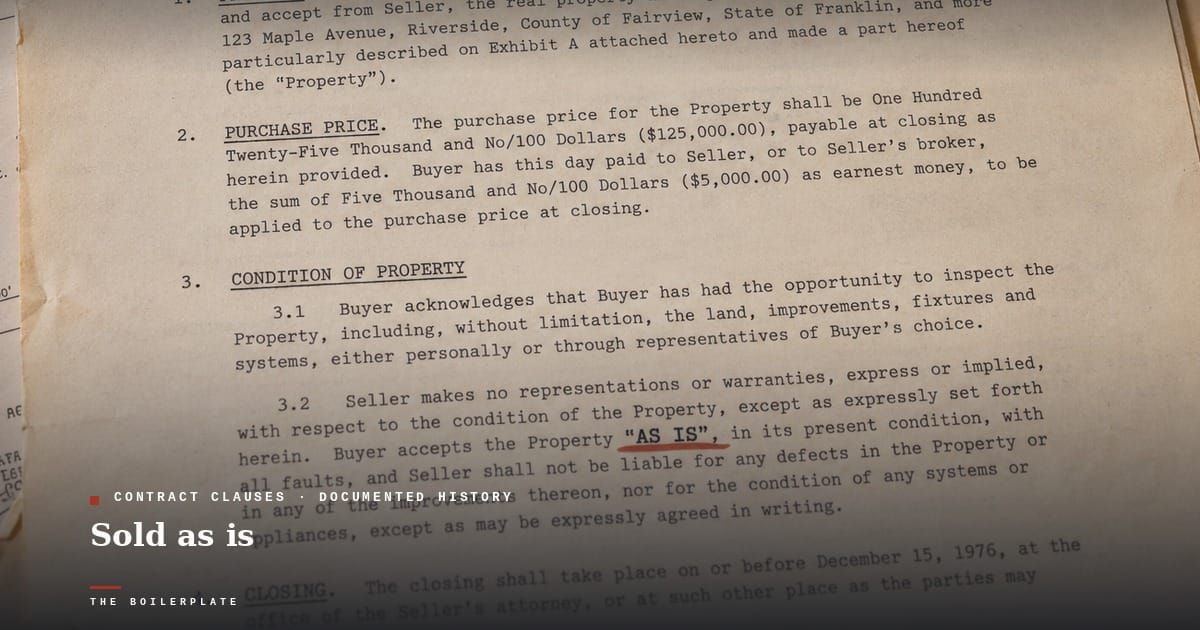
unless the circumstances indicate otherwise, all implied warranties are excluded by expressions like "as is", "with all faults" or other language which in common understanding calls the buyer's attention to the exclusion of warranties and makes plain that there is no implied warranty.
The Language
The same three words show up in three very different documents, doing slightly different work in each.
In the statute itself, Uniform Commercial Code § 2-316(3)(a) reads: "unless the circumstances indicate otherwise, all implied warranties are excluded by expressions like 'as is', 'with all faults' or other language which in common understanding calls the buyer's attention to the exclusion of warranties and makes plain that there is no implied warranty."
On a used-car lot, it shows up as a checkbox. The Federal Trade Commission's Used Car Rule requires dealers to post a window sticker, the Buyers Guide, disclosing whether a vehicle is sold with a warranty or "as is," and the FTC's own consumer guide reproduces the required language: "THE DEALER DOES NOT PROVIDE A WARRANTY FOR ANY REPAIRS AFTER SALE. AS IS - NO DEALER WARRANTY."
And on ordinary commercial paper, it can be one clause typed into a receipt. In a 1972 dispute over a shipment of pullets, the seller's own receipts read:
shall be deemed to be accepted in an "as is" condition — receipt language at issue in Woodruff v. Clark County Farm Bureau Cooperative Ass'n, Inc. (Ind. Ct. App. 1972)
Whether that clause actually did its job is a different question, taken up below.
Plain-English Translation
"Sold as is" does one specific job under the Uniform Commercial Code: it excludes the implied warranties, the warranty of merchantability and the warranty of fitness for a particular purpose, that the law would otherwise read into a sale of goods. It does not, by itself, cancel any express warranty the seller separately made. A specific factual claim or affirmation about the goods survives an "as is" disclaimer unless the seller separately disclaimed that too.
Nor is the exclusion automatic just because the words appear on the page. The statute conditions it on context: implied warranties are excluded "unless the circumstances indicate otherwise," not simply "if" the words show up, but unless something about the circumstances cuts the other way. Courts have used that opening to hold a disclaimer ineffective when it wasn't actually conspicuous to the buyer, even where the words "as is" were technically present.
The same three words also carry different legal weight depending on what's being sold. "As is" in a UCC sale of goods, "as is" on a used-car Buyers Guide, and "as is" in a real estate contract are governed by three different bodies of law - the Uniform Commercial Code, federal trade regulation, and state property and disclosure law, respectively - and the consequences don't automatically carry over from one context to another, even though shoppers commonly treat the phrase as one uniform concept.
Before This Language Existed
Long before "as is" was a term of art, buyer-beware was simply how English sales law worked. Caveat emptor placed the burden on the buyer to reasonably examine goods or property before buying them, rather than obligating the seller to guarantee soundness the buyer hadn't separately bargained for, though the doctrine has long recognized an exception for a seller who conceals a defect he has a duty to disclose.
An early illustration survives from 1603. In *Chandelor v. Lopus*, an English court held that a seller's bare assurance that a stone was a "bezoar stone," then believed to have medicinal properties, wasn't grounds for a lawsuit on its own; the buyer could recover only by showing the seller knew the claim was false, or had expressly warranted it. Buyer-beware was already the operating default in English sales law more than three centuries before "as is" existed as codified language.
Over the 19th century, English courts began carving narrow exceptions into that default. In *Jones v. Just* (1868), the Court of Queen's Bench held that goods sold "to arrive," which the buyer had no chance to inspect before the sale, still had to match their contractual description and be merchantable once they arrived; caveat emptor, the court reasoned, presupposed an opportunity to inspect that didn't exist here. That English line of authority was later received into American law, though this record does not independently confirm a matching 19th-century American case.
England eventually wrote its exceptions into statute. The Sale of Goods Act 1893, and its successor the Sale of Goods Act 1979, codified implied warranties of merchantable (later "satisfactory") quality and fitness for purpose directly into English law, a parallel, earlier codification path to the one the United States would eventually take.
By the early 20th century, American law was also moving, just not toward more disclaiming power. In *MacPherson v. Buick Motor Co.* (1916), Judge Benjamin Cardozo, writing for the New York Court of Appeals, eliminated the requirement that a buyer be in direct contractual privity with a manufacturer in order to sue over a dangerously made product. Legal scholarship has widely described that holding as a turning point toward greater manufacturer and seller responsibility, sometimes summarized as a shift from caveat emptor toward "caveat venditor," let the seller beware. The tension is real: the same decades that produced *MacPherson*'s expansion of seller responsibility also produced the statutory tool, taken up next, that let sellers opt back out of it.